jueves, 2 de abril de 2015

Pasqua - Easter


Donem la benvinguda a la primavera. És el temps on tot reneix, tenim més hores de llum (que no vol dir de sol… ), el color comença a ser present altre vegada, deixant enrere el color blanc, gris i negre que es caracteritza l’hivern finés. Però les paraules se les emporta el vent... com pots veure a la fotografia encara hi ha neu i els dies són grisos. Mentre esperem que el bon temps arribi la mainada donen la benvinguda a la primavera amb dos fets.


branques de salze decorades


Test amb raigràs
El primer esdeveniment és que els nens i nenes recullen branques de salze que comencen a florir i les decoren amb papers de colors, plomes... (com pots veure a la primera fotografia). El diumenge de Rams els nens i nenes es disfressen de bruixes i bruixots , porten les branques decorades, un cistell  i van a tocar porta per porta als veïns. Quan els veïns obren la porta, la mainada diuen: Virvon, varvon, tuoreeks terveeks, tulevaks vuodeks; vitsa sulle, palkka mulle! que seria: Et saludo amb la branca, per desitjar-te un any fresc i saludable; una branqueta per a vostè i una recompensa per a mi! Per tant, ofereixen la branca a canvi de llaminadures, xocolatines...

El segon esdeveniment és que la mainada sembren llavors de raigràs en un test per veure com de les llavors en surt herba fresca i verda.  


Mämmi
El postra típic durant la Pasqua és el Mämmi. Diguessim que no és un postre que t'entri pels ulls ja que aparentment sembla... bé, una altra cosa...

El Mämmi està fet d'aigua, farina de sègol, sègol i malta en pols, melassa fosca, sal i ratlladura de taronja i la seva textura és com púding. Normalment els finesos ho compren fet perquè per elaborar-lo a casa comporta dies. Es menja acompanyat de crema o gelat, perquè sol costa de menjar. No sabria com descriure el seu gust, és especial, l’hauries de provar! Diria que no he conegut cap finés que li agradi... de fet, conec algú que coneix algú que li agrada el Mämmi...


Que bonic es poder compartir diferents cultures, aprenent i ensenyant, o en aquest cas menjant una bona mona de Pasqua feta a casa!!


--------------------------------


We welcome the spring; it’s the time when everything will be reborn, we have more daylight hours (that it is not the same as seeing the sun...), the colour begins to present again, leaving behind the white and grey that were the main colours in the Finnish winter. But, nothing is as the words say... as you can see in the picture, there is still some snow and the grey days are still present. 

pussy willow branches


ryegrass
The children welcome the spring with two things.  


The first is that the children will pick up some pussy willow branches and they decorate them with colourful papers and feathers.... (first picture). Usually they dress on to witches and they bring with them the willow branches and a Basket. They walk from door to door and ring the door bells on Palm Sunday.  When the door is opened, the children say: “Virvon, varvon, tuoreeks terveeks, tulevaks vuodeks; vitsa sulle, palkka mulle!” That it means: I wave a twig, for a fresh and healthy year ahead; a twig for you, a reward for me!  After this beautiful message they get candies, chocolates… 

The second thing is that they plant ryegrass in pots to see as it grows up.


The typical Finnish dessert in Easter time is the Mämmi. The first time that you see it, you think that this seems… well, something else...


Mämmi
Mämmi is made of water, rye flour, and powdered malted rye, seasoned with dark molasses, salt, and dried powdered Seville orange zest. Usually the Finnish people buy it in the supermarkets because if you want to make it yourself, it will take days. Habitually they eat it with cream or ice-cream, it will taste better. I don’t know how to describe its taste, but it is special. You have to try it! I think I don’t know any Finns who like Mämmi… Actually, I know someone who knows someone, who likes Mämmi.


It is really nice to share different cultures, learn and teach, or in this case to eat a typical catalan dessert in Easter made at home called Mona de Pasqua. 


sábado, 28 de marzo de 2015

El naixement d'un nadó- The birth of the baby


Esperar un nen sempre és una alegria per a tota la família, així que els pares sempre han de respondre a un reguitzell de preguntes: serà nen o nena? Per quan l’espereu? Com es dirà?... A Finlàndia, no es necessari fer la última pregunta (em va quedar clar quan ho vaig preguntar per primera vegada i vaig veure la cara dels finesos…) ja que el nom de la criatura es decideix un cop neix. El primers mesos els pares decideixen el nom que li podria quedar bé tenint en compte el comportament, l’aparença física... del nounat! 


Els pares normalment utilitzen un sobrenom per la criatura i quan els familiars o amics van a visitar el nadó poden suggerir algun nom. El 75 % dels finesos són membres de l’església Evangèlica Luterana, així que passat uns mesos la família convida a  familiars i amics perquè el nounat rebi el baptisme. És moment també d’anunciar els noms de la criatura. Normalment els pares trien dos o tres noms com a nom.

Normalment, els pares tenen el mateix cognom després de casar- se (avui dia es pot triar si quedar-se amb el cognom de la dona o l’home), així que el nadó rep el mateix cognom. Els finesos només tenen un cognom.

Com una coseta tan petita et pot captivar i entendrir-te tant que podries estar hores i hores mirant-la... que bonica és la vida!!


Gràcies per deixar-me viure aquests moments! :)


                                              ------------------------------------              


Waiting for the baby to be born is always full of happiness for all the family, so the parents always want to have answers to a lot of questions such as: Will the baby be boy or girl? When the baby will be born? What will be the name of the baby?... In Finland, it is usually not necessary to have the answer to the last question, because the name of the baby has not to be decided when the baby is born. During the first two or three months the parents decide the names that could fit the baby considering the baby’s behavior, physical appearance...


The parents usually use a nickname for the new member of the family, and when the relatives or friends go to visit the baby, they can suggest some names. 75 % of Finns are member of the Evangelical Lutheran church, so after two or three months the family will invite the closest relatives and friends for the baby’s christening. In this event, the priest will announce the names of the baby. Usually the parents choose two or three first names.

The surname is always the same as the parents’ surname. Usually the parents have the same surname after getting married, so the children get the same surname. The Finnish people only have one surname.  

As a small baby can captivate your love, so that you could see her hours and hours... life is beautiful! :) 


Thank you for you let me live these moments! :) 

viernes, 27 de marzo de 2015

Sistema educatiu


En construcció..... visitant escoles!!! :)


Qui sóc?


Em dic Eva. Sóc Integradora social i mestra d’educació Primària i Especial. En acabar la carrera em vaig preguntar, i ara què faig amb la meva vida? Vaig decidir que volia sortir de Catalunya per conèixer món i noves cultures. La millor manera de conèixer una cultura amb propietat és viure amb la gent del país. Vaig endinsar-me a l'aventura de fer d’au pair a Finlàndia amb tres reptes en ment:  

1.Conèixer en primera persona el sistema educatiu de Finlàndia, un referent mundial.
2. Conèixer una cultura completament diferent a la meva i viure en un país on el clima és de contrastos.
3. Millorar el meu anglès i intentar aprendre finès.


Una miqueta més sobre mi

M’agrada

… caminar sense rumb observant tot el que m’envolta, tan sigui per la ciutat o per la muntanya.

… anar sense presses, però sense pausa.

… gaudir d’una tassa de té amb bona companyia.

… qualsevol dolç que tingui xocolata.

… trobar l’ordre dins el meu desordre.

… conèixer la persona que s’amaga darrera d’un somriure.


DESCOBRIR el món amb els meus propis ulls!


BENVINGUT! :)

Si voleu contactar amb mi, cliqueu aquí 


                                                       -------------------------------


My name is Eva. I’m from Catalonia (Spain). I’m social integration and elementary and special teacher. When I finished my career, I asked myself, what do I do with my life? I wanted to go out from Catalonia and know the world and new cultures. Live with native people is the best manner possible for know the authentic culture. So, I decide to start the adventure as an au pair in Finland with three challenges in my mind:

1. Know in first person as it works the system education in Finland, it is global example.
2. Know a culture totally different of my culture and live in a country when the climate is of contrasts.
3. Improve my English skills and try to learn Finnish.

A little bit about me 

I like...

… to walk without direction analyzing everything around me, so in the city or in the mountain.

… to go slow but steady.

… to enjoy to take a cup of tea in good company.

… to eat chocolate sweets. 

… to find my order into my mess.

… to know the person who hide behind a smile.


…to DISCOVER the world with my own eyes!


WELCOME! :) 


If you want to contact with me, click here

domingo, 22 de marzo de 2015

Aurores boreals - Aurora borealis

Feta per la meva mare d'acollida :) 
Es presentava un vespre normal.... quan de sobte em vaig assabentar que en el poble on visc es podien veure aurores boreals. Aquest fenomen normalment es veu al nord de Finlàndia no al sud, així que és un fet no habitual, passa un cop cada deu anys. Has estat de sort! - em deien els finesos!! :)

Vam agafar el cotxe per abandonar el poble i endinsar-nos en la foscor. Vam sortir del cotxe i vam veure que el cel era de color verd, que estava en moviment continu dibuixant formes, que cada moment et sorprenia... vaig sentir un cúmuls de sentiments d’alegria, bogeria, il·lusió... que no es pot transmetre amb paraules. La realitat supera la ficció.


Les aurores boreals es produeixen per la interacció del vent solar amb el camp magnètic terrestre. Aquest vent solar interactua amb el camp magnètic terrestre que està carregat de partícules carregades de ions (principalment protons i electrons) que xoquen amb els gasos de l'aire de la Terra. Aquest xoc de partícules produeixen les aurores boreals. Cada gas produeix una llum diferent, per  exemple el color vermell es deu a l’oxigen, el verd es deu a la barreja d’oxigen i hidrogen i el color blau es deu el nitrogen. 

No em podia cansar de mirar el cel, m’hipnotitzava, però endinsar-me en el món dels somnis veient com el cel era màgic... fantàstic. 


LA VIDA ÉS MÀGICA :)


                                                          -------------------------------


by my host mother :)
It was a normal evening... when suddenly I found out that in the town where I live, you could see aurora borealis. Usually this fenomen could be see only in the North of Finland not in the South, so it could be an unusual event happening only once per decade. I have had good luck, the Finnish people said  

We took the car and drove away from the reach of the city lights. When we stepped out of the car, we saw that the sky had green colour, some shapes were in continuous motion drawing forms, every time you gave a glance, it looked different... I felt a variety of feelings such as joy, craziness, excitement, enchantment… I can’t describe it with words.  


The northern lights are produced by the interaction of the solar wind with the Earth's magnetic field. This wind interacts with the Earth's magnetic field that is loaded with ions of charged particles (electrons and protons) that collide with gases in the atmosphere of the Earth. This collision of particles produces aurora borealis. Each gas produces a different colour , for example red colour is due to oxygen, green is due to the mixture of oxygen and hydrogen and blue colour is due to nitrogen. 
I could not of looking at the sky, I went into the world of dreams watching the sky in constantly moving, is fantastic. 

LIFE IS MAGICAL :)

sábado, 7 de marzo de 2015

Activitats hivernals -- Winter activities


Durant els mesos d'hivern la ciutat i els boscos es vesteixen de blanc i el fred l'acompanya, de moment la temperatura mínima que he vist és -18 °C. S'ha de dir que el mes de gener i febrer han estat temperats. El febrer és el mes més fred però les temperatures han estat  entre -10 i +4 °C, segons els finesos no és habitual aquestes temperatures, així que estem vivint un hivern temperat. Per tant, quines són les activitats que puc gaudir en l'entorn que m'envolta?

1. Tornar a sentir-me com un nena, fent ninots de neu, guerra de boles de neu, baixar amb trineu... quan jugo amb els nens no se qui més gaudeix si ells o jo... 


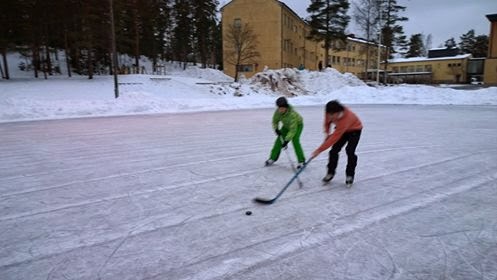
2. A tots els patis de les escoles hi ha pistes esportives, així que a l’hivern aquestes es converteixen en pistes de gel a l’aire lliure. Així que l’hora d’educació física agafen els patins i/o els pals de Hockey i cap a fer exercici a fora. Les pistes de gel són obertes per tothom, per tant, tu pots anar a patinar a l’aire lliure i de manera gratuïta. Si es dins l’horari escolar pots compartir la pista amb els alumnes. Tot i que no cal anar a les pistes de gel per patinar ja que ara els carrers estan glaçats i rellisques fàcilment, per tant quan surt fora has de caminar amb precaució perquè és perillós. 


3. Caminar pel bosc amb raquetes de neu. El poble on visc hi ha una associació que organitza sortides i de manera gratuïta et deixa les raquetes de neu i et fan de guia. Genial !! En els boscos hi ha aquestes petites casetes on pots descansar. En el seu interior hi ha bancs i un espai per fer foc per escalfar-te o per coure menjar. Tradicionalment, els finesos couen salsitxes!


4. Plogui, nevi, faci fred o faci calor els finesos agafen la bicicleta igual, així que a l'hivern l'únic que cal fer és canviar els pneumàtics de la bicicleta i anar amb més precaució quan vas amb la bicicleta. És important recordar que quan surts quan el sol s'ha amagat és imprescindible agafar armilles reflectants o reflectants per fer-te veure, llum per la bicicleta i el més important, el casc per la teva seguretat. 


5. Els agutzils de la ciutat preparen les pistes per fer esquí de fons en els boscos de la ciutat. Així que per gaudir d'aquest esport només cal agafar els esquis de fons, botes i pals, sortir de casa i començar a esquiar. Una activitat al costat de casa i gratuïta, que més vull. Com que tot és pla, és perfecte per aprendre aquest esport nou per mi. Com podeu veure a la foto he provat de practicar aquest esport també en els llacs glaçats. 


6. Conduir pel llac. En alguns llacs es formen carreteres de gel, així que pots conduir sobre del gel, així que pots anar a visitar el veí de manera més ràpida sense utilitzar la carretera habitual. Però abans de travessar el llac es aconsellable assegurar-se que el gel està en condicions. Abans de creuar el llac hi ha un senyal de tràfic  “jäätiellä ajo omalla vastuulla” que significa que conduir per aquesta carretera es responsabilitat teva. 


7. En el llac tu també pots pescar. Així que només es necessita l’estri per fer el forat, la canya de pescar amb un esquer i alguns cucs. Vàrem anar cap al llac a buscar el millor lloc i seguidament vàrem fer el forat. El forat tenia un gruix de 60 cm, així que era segur està caminant pel llac. Després vàrem preparar la canya i esperar fins a pescar algun peix, però no hi va haver sort.


8. Napakelkka és una atracció tradicional finesa que es pot gaudir també en els llacs.  Aquesta consisteix en que hi ha dos pals, un d’aquest és curt i està clavat al gel, l’altre és més llarg i està col·locat de tal manera que un extrem toca al terra i l’altre està clavat en el pal petit. A l’extrem que toca al terra hi ha un trineu. Així que t’asseus allà i necessites algú en el centre on hi ha el pal petit per comença a empènyer per tal de donar voltes i voltes. 


CURIOSITAT: A l'hivern els nadons no fan la migdiada a dins a casa calentones... no no.. sinó que els pares els ben abriguen, els posen dins al cotxet i a fer la migdiada a fora al jardí que estan més fresquets. El primer moment que m'ho van explicar vaig flipar una mica, però vaig veure que és un costum de Finlàndia i d’altres països nòrdics. La creença és que és saludable respirar una mica d'aire fresc i el son és més profund, potser no és una mala idea! Si voleu saber més podeu mirar aquest vídeo.  


Nähdään pian :)


                                                                       -------------------------------------------------


WINTER ACTIVITIES


During the winter months, the city and the forest dress on with white color accompanied with the freeze. At this moment, the minimum temperature that I have seen was -18 °C. This January and February it has been temperate. February usually is the coldest month, but the temperature has been between -10 and +4 °C. The Finnish people say that this weather is not usual, so we are living a warm winter. Which kind of the activities can I enjoy in this environment?

1. Feel like a little girl again and make a snowman, set up a war and throw snow balls or go down the hill with a sled… so when I play with the children I don’t know who enjoys more, they or I…


2. There’s a small sports field in every school yard, and in the winter the town employees will make it an ice skating rink, so that the children can take the skates (and hockey sticks) and exercise outside. The ice rinks are actually open to everyone, so you can go skating outdoors and it is a free activity, although during the school day you should step aside if there’s a school class skating. But now, the streets are frozen and very slippery, so when you go out you should pay attention, because it is dangerous.  


3. Walk through the forest with snowshoes. There is an association that organizes such events in the city where I live. They borrow you the snowshoes and guide you for free. In the forest, there are usually small huts where you can sit and rest. There is also a place for a camp fire, so you can warm up or cook some food, too. Traditionally, the Finnish people eat sausage at the camp fire!


4. Whatever the weather: rain or snow, cold or hot, the Finnish people ride the bicycle anyway. In the winter, you’d better put on the studded tires on the bicycle and ride with a little more of precaution. It’s important to remember, that when you go out in the dim or dark, it is essential to put on a reflective vest, a white front light on the bicycle and the helmet for your security. 


5. The city employees prepare some cross country skiing tracks in the walking paths in the forests. Enjoy this sport, because it is easy; you have to take only the skis, shoes and sticks, go out from home and begin to ski. It is a free activity and nearby the house, so it is perfect. Everything is simple, so that it is great to learn this sport, which is new for me. You can also practice this sport on the lake in the winter time when the lake is frozen. But remember: once the cross country skiing tracks are made on the path, they are only for the skiers, so you should not walk on the paths!


6. Driving a car on the lakes. There will be some “ice roads” made on the lakes, where you can drive and you can visit the neighbor on the opposite shore quickly without using the “traditional” roads. But before you go across the lake, make sure that the ice is strong enough. There is also a traffic sign “Jäätiellä ajo omalla vastuulla” which means “Driving on ice road at your own risk”.


7. At the lake you can go ice fishing, too. For that you only need an ice drill to make the hole, a fishing rod with a bait and some maggots. We went on to the lake and we chose the best place to drill a hole. After drilling we noticed that the ice was about 60 cm thick. Then we just started fishing. But we didn’t have any luck.


8. Napakelkka is a traditional Finnish outdoor fun in the winter. You need two poles: a shorter one to put up on the ice and a longer one that is attached on the shorter pole on the other end. There is a sled on the outer end of the longer pole.  Then you just have to sit down on the sled, and someone will push the longer pole to make the sled go around and around. It is a funny activity.


CURIOSITY: In the winter time the babies don’t usually take a nap inside the house in a warm temperature. Instead, the parents dress the baby warmly for sleep outside in the garden.  The first moment that someone told me about this, I felt a little surprised, but then I learned that it is an old habit in Finland and other Nordic countries. The belief is that it is healthy to have some fresh air, maybe it is not a bad idea! If you want to know more about that click this video!  


Nähdään pian :)


sábado, 14 de febrero de 2015

Wanhojen tanssit


Ahir vaig assistir a una celebració finesa anomenada  wanhojen tanssit.  Els alumnes de l’escola superior, ells tenen 17-18 anys, passen a convertir-se els grans de l’escola. Per aquest motiu es vesteixen per la ocasió.  Les noies semblen princeses, ja que els vestits que porten i els pentinats són espectaculars i els nois es posen l’esmòquing. Feien molt de goig!!

A la pista de ball hi havien aproximadament 100 parelles que durant una hora van estar ballant diferents balls com:
  •           Balls  tradicionals cicapo, polonaise, wengerka, pas d’Espagne, Pompadour  
  •           Balls de saló com el tango, el vals vienès, rock and roll.
  •           Coreografies grupals per exemple seguint el ritme de les asereje.   

 Gaudiu del vídeo :) 

                                                            ---------------  


Yesterday I assisted a Finnish celebration called wanhojen tanssit. The pupils in upper secondary school, they are 17-18 years old, become the seniors of the school. For this reason they dress on for the ocassion. The ladies become princesses because their dresses and hairstyles are amazing and the boys put on the tuxedo.
In the dance floor there were 100 partners that during one hour they show us different traditional dances include:
  • Traditional dances cicapo, polonaise, wengerka, pas d’Espagne, Pompadour
  • Ballroom dancings like tango or viennese waltz
  • Grupal choreography.


Enjoy the video :)